 Caregiver Stories
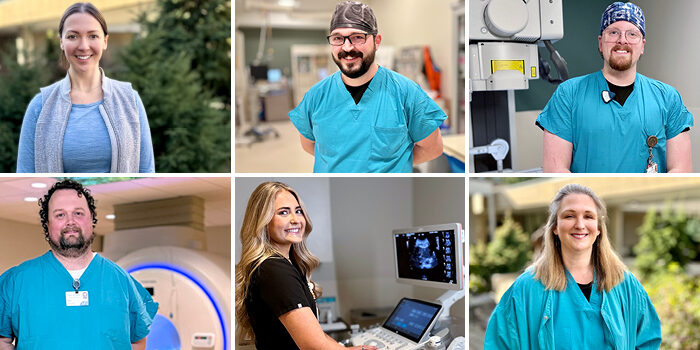
Which imaging specialty is the best? These six techs have six different answers.
Diagnostic imaging is a popular career choice: it offers job stability, strong earning potential, and a rewarding mix of technological expertise and human connection. But which modality is the best? Ask six imaging technologists at Providence Swedish, and you’ll get six different answers.
X-ray and CT: fast-paced and foundational
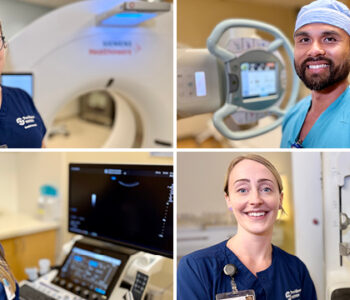
Radiologic Technologist Andrew and CT Technologist Lory
Andrew believes X-ray is the best specialty because of the variety. “We keep a rotation, so the day stays varied,” he explains. His shifts take him all over the hospital, from the emergency department to inpatient floors, the fluoroscopy room or even into the operating room.
While Lory’s patients are transported to her, she also enjoys the high energy pace and even the unpredictability. “You might come in and there’s 50 patients on the list,” she says. “But it’s job security. CT and X-ray are first line coming in.”
Andrew adds that imaging techs play a critical role in surgery. “We’re the eyes of the OR. Without X-ray, you can only see what’s surface level. In spine surgery, for example, we help confirm exactly where screws are placed, and we work alongside robotic systems that use a CT scan as a map and X-ray to ground it in real time. It’s the coolest thing: Every day feels like a step closer to Star Trek.”
MRI: focused care and meaningful patient connection
Lead MRI Technologist Tosh
For Tosh, MRI is special because of the personal attention he can give patients. “I get to just focus on the person in front of me; they’re my only patient at a time,” he says. “And because MRI exams can run anywhere from 13 minutes to three-plus hours, you’re building a real rapport.”
That time allows him to calm patients’ nerves. “I used to be pretty claustrophobic going into MRIs myself, so I have a lot of empathy for patients who are nervous about it,” he shares. “Spending an extra five minutes to reassure someone, get them settled, and make them feel safe, that matters.”
Nuclear medicine: cutting-edge technology and investigative work
Nuclear Medicine Technologist Anna
Anna is drawn to nuclear medicine because it combines advanced technology with problem-solving. “I like to find the root cause of things and to help people,” she says. “We’re basically doing inside-out imaging. More or less, we’re injecting X-rays instead of letting the cameras emit them.”
The work spans multiple systems and conditions. “I love that I have a wide scope of involvement with the different functions. We do everything from bone scans to heart scans to liver, renal and cancer scans. For pretty much any organ that you have in your body, we can evaluate some function, whether or not it’s operating efficiently or properly,” she explains “Our images look very different from other scans. They give us a lot of high-quality functional resolution.”
Work with us in Nuclear Medicine
Interventional radiology: hands-on impact in real time
Lead Interventional Technologist Tyler
Tyler cross-trained into interventional radiology from X-ray, and he’s glad he did, because as he explains, it offers something unique.
“Diagnostic imaging is documenting disease,” he shares. “In IR, we see the problem, we take care of the problem. We’re not going to see the problem, write a report and let somebody else take care of the problem. We’re going to do it right now. That’s the jazz of IR.”
Work with us in Interventional Radiology
Ultrasound: complex cases and constant discovery
Ultrasound Technologist Megan
Most people assume that ultrasound techs work with mothers-to-be all day, but it’s the complexity and array of cases that make ultrasound the best imaging specialty for Megan.
“Within ultrasound, there’s OB-GYN, abdomen, small parts, vascular, musculoskeletal…there are a lot of options,” she explains. “I love vascular because there are so many different reasons you would be doing it, and it’s kind of like a problem you have to solve. It’s complex in a good way. A lot of times, it’s somebody who’s not getting blood flow to an extremity.”
New technology keeps the field evolving. “We recently started using transcranial dopplers, which allow us to assess blood flow in the brain. It’s new and exciting.”
Finding your purpose in diagnostic imaging at Providence Swedish
No matter their specialty, these techs agree on one thing: diagnostic imaging is ultimately rewarding because it helps people. Megan sums it up by saying, “I feel like it gives me a sense of purpose in the sense that we are assisting in somebody’s diagnostic process. Whether we find nothing, and it at least tells them somewhere else to look, or we find something, and it helps point them in the direction of where to go next, we’re always helping people find what’s wrong and move toward feeling better.”
No matter your current specialty or the one you’re aiming for, we have roles to suit every tech. Check out our open imaging jobs.